
Executive Summary
This blog synthesizes findings on the increasing frequency of heat waves in Pakistan and provides future projections based on climate modeling. A historical analysis of data from 1997 to 2015 reveals a significant rising trend in heat wave events across the provinces of Punjab, Sindh, and Baluchistan. Projections using the SimCLIM climate model indicate a severe and accelerating increase in heat accumulation through 2090, with southern Punjab and Sindh identified as primary hotspots.
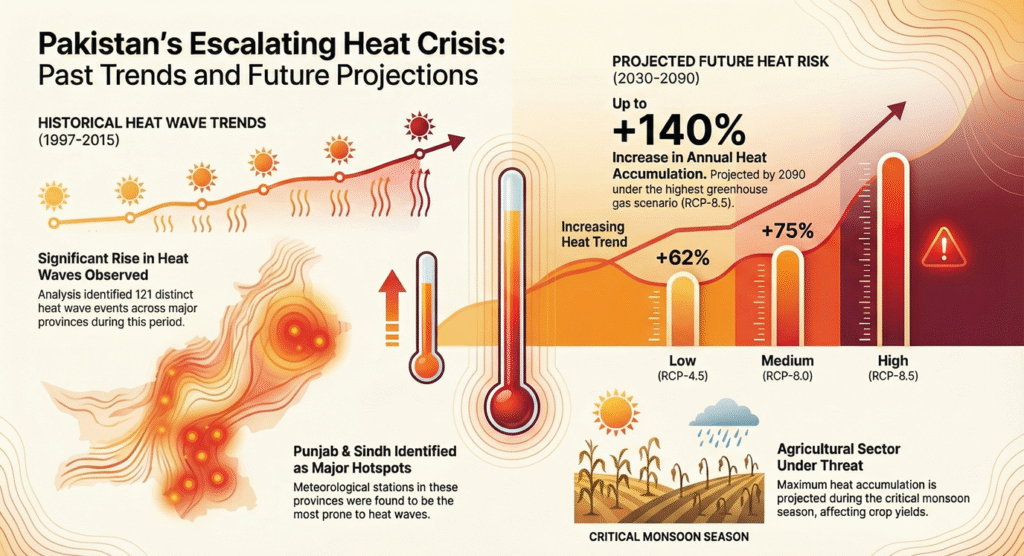
Under the highest greenhouse gas concentration scenario (RCP-8.5), annual heat accumulation is projected to increase by 32% by 2030, 86% by 2060, and a dramatic 140% by 2090 compared to the baseline year of 1995. Seasonal analysis shows the most intense heat accumulation occurring during the pre-monsoon and monsoon periods, posing a direct threat to regional agricultural activities and water security. The study concludes that the risk of frequent droughts and heat waves is high, underscoring the urgent need for targeted adaptive measures to mitigate the impacts of climate change.
1. Introduction and Context
Climate change is exerting adverse effects globally, and Pakistan is particularly vulnerable due to its location in a climatically warm geographical region. The nation is susceptible to extreme climate events such as heat waves, droughts, and floods. According to the Global Climate Risk Index 2014, Pakistan was ranked the third most climate-affected country. The temperature increase in this region is expected to be higher than the global average, which rose by 0.76°C during the 20th century.
Key impacts of this warming trend in Pakistan include:
- Glacier Melt: Rapid receding of glaciers in the Hindu Kush, Karakoram, and Himalayan ranges, increasing the risk of floods and subsequent droughts.
- Security Threats: Potential for serious threats to the country’s water, food, and energy security.
- Public Health: Increased risk of heat strokes, health diseases, and human mortality. A heat wave in 2015 killed over 200 people in one week.
- Agriculture: The agricultural sector is highly vulnerable to the impacts of climate change, affecting crop yields and rural livelihoods.
This analysis is based on a study that assesses historical heat wave trends and projects future heat accumulation to identify regional “hotspots” and inform sustainable adaptation strategies.
2. Study Methodology
The research employed a two-pronged approach: analyzing historical temperature data to identify past trends and using a climate model to project future scenarios.
- Study Area: The analysis focused on the provinces of Punjab, Sindh, and Baluchistan in Pakistan.
- Historical Data Analysis:
- Daily maximum temperature data from 1997–2015 were obtained from the Pakistan Meteorological Department (PMD) for 29 weather stations.
- Heat wave events were identified based on standard criteria recommended by the PMD:
- Maximum temperature reaches >45°C for plains and >40°C for hilly areas.
- When the average maximum temperature is 42°C, a rise of 5°C to 6°C for 8 or more days is considered a heat wave.
- A maximum temperature exceeding 45°C for more than 8 days is considered a heat wave, irrespective of the normal trend.
- Future Climate Projection:
- Model: The study utilized the SimCLIM software system, a statistical downscaling model, to project future heat accumulation (expressed in “degree days”).
- Climate Scenarios: Projections were generated using an ensemble of General Circulation Models (GCMs) combined with three Greenhouse Gas (GHG) Representative Concentration Pathways (RCPs) from the IPCC’s Fifth Assessment Report (AR5):
- RCP-4.5: Low GHG concentration scenario.
- RCP-6.0: Median GHG concentration scenario.
- RCP-8.5: High GHG concentration scenario.
- Time Horizons: Projections were calculated for the years 2030, 2060, and 2090 against a baseline year of 1995.
3. Historical Heat Wave Trends (1997–2015)
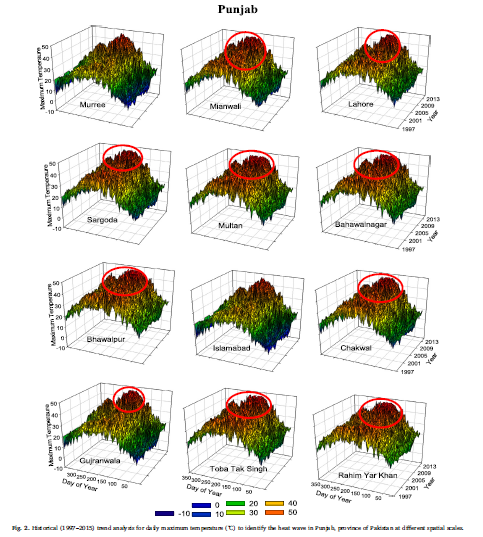
The analysis of historical data confirmed a significant increase in heat wave events across the studied provinces. A total of 121 distinct heat wave events were identified at 18 of the 29 meteorological stations analyzed. The provincial breakdown reveals specific areas of high vulnerability.
| Province | Stations with Events / Studied | Total Events Identified | Key Hotspots with Maximum Events |
| Punjab | 10 of 12 | 73 | Rahim Yar Khan |
| Sindh | 5 of 7 | 33 | Khairpur, RCW Rohri |
| Baluchistan | 3 of 10 | 15 | Nok-Kundi |
The trend analysis shows that meteorological stations in Punjab and Sindh are highly prone to heat waves, with Rahim Yar Khan in Punjab experiencing the highest frequency of events during this period.
4. Future Projections for Heat Accumulation (2030, 2060, 2090)
The SimCLIM model projects a substantial increase in annual and seasonal heat accumulation across Pakistan, with the intensity escalating over time and with higher GHG emission scenarios. The regions most affected are consistently identified as southern Punjab and Sindh.
4.1. Annual Heat Accumulation
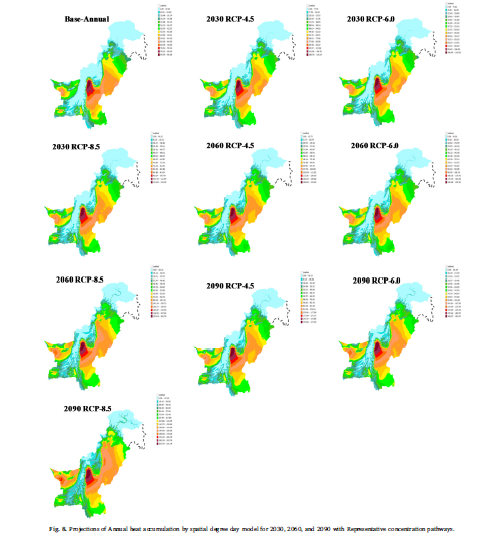
Projections for annual heat accumulation show a clear and intensifying trend throughout the 21st century. The risk is projected to be most severe in northern Sindh.
- By 2030: Annual heat accumulation is projected to increase by 17% (RCP-4.5), 26% (RCP-6.0), and 32% (RCP-8.5).
- By 2060: The increase accelerates to 54% (RCP-4.5), 49% (RCP-6.0), and 86% (RCP-8.5).
- By 2090: The projected increase reaches its peak at 62% (RCP-4.5), 75% (RCP-6.0), and 140% (RCP-8.5).
4.2. Seasonal Heat Accumulation
The seasonal analysis reveals that the pre-monsoon and monsoon periods will experience the most significant increases in heat accumulation, directly impacting agricultural cycles.
- Pre-monsoon (March, April, May): This season shows a sharp temperature rise, which can cause early maturity of crops like wheat and negatively affect yields. The highest risk is concentrated in southern Punjab and Sindh.
- Monsoon: High heat accumulation is projected for Punjab, Sindh, Baluchistan, and Khyber Pakhtunkhwa. Although there is a slight decrease in maximum temperatures compared to the pre-monsoon season in some areas, the overall heat accumulation remains dangerously high.
- Post-monsoon: While this season has the lowest overall heat accumulation, a clear increasing trend is projected, particularly in Sindh. By 2090, under the RCP-8.5 scenario, southern Punjab, Sindh, and lower Baluchistan are projected to face significant threats.
4.3. Summary of Projected Heat Accumulation
The following table details the projected percentage change in heat accumulation compared to the 1995 baseline for different seasons and scenarios.
| Period | Base HA | 2030 % Change (RCP 4.5/6.0/8.5) | 2060 % Change (RCP 4.5/6.0/8.5) | 2090 % Change (RCP 4.5/6.0/8.5) |
| Pre-Monsoon | 200 | 35% / 36% / 41% | 74% / 67% / 116% | 88% / 113% / 130% |
| Monsoon | 758 | 22% / 24% / 24% | 63% / 33% / 34% | 56% / 52% / 93% |
| Post-Monsoon | – | 46 / 45 / 49* | 57 / 57 / 76* | 65 / 73 / 127* |
| Annual | 906 | 17% / 26% / 32% | 54% / 49% / 86% | 62% / 75% / 140% |
Note: The Post-Monsoon figures represent absolute heat accumulation (HA) values, as baseline data was not available for comparison.
5. Conclusion and Implications
The findings present a clear conclusion: Pakistan is facing a significant and escalating threat from heat waves due to climate change.
- Validated Trend: Historical data analysis confirms that heat wave events have significantly increased over the past two decades.
- Future Risk: Climate models project a high risk of more frequent and intense droughts and heat waves in the coming decades, particularly concentrated in the provinces of Sindh and southern Punjab.
- Agricultural Impact: The projected increase in heat accumulation during the critical pre-monsoon and monsoon seasons will adversely affect crop-yield parameters, threatening food security.
- Call for Action: The identification of specific temporal and spatial “hotspots” provides critical information for policymakers. This study emphasizes the necessity of using climate model projections to develop timely and region-specific adaptive measures to ensure sustainable development and manage natural resources effectively.
Hey there, You’ve done an incredible job. I will definitely digg it and personally suggest to my friends. I am confident they’ll be benefited from this site.